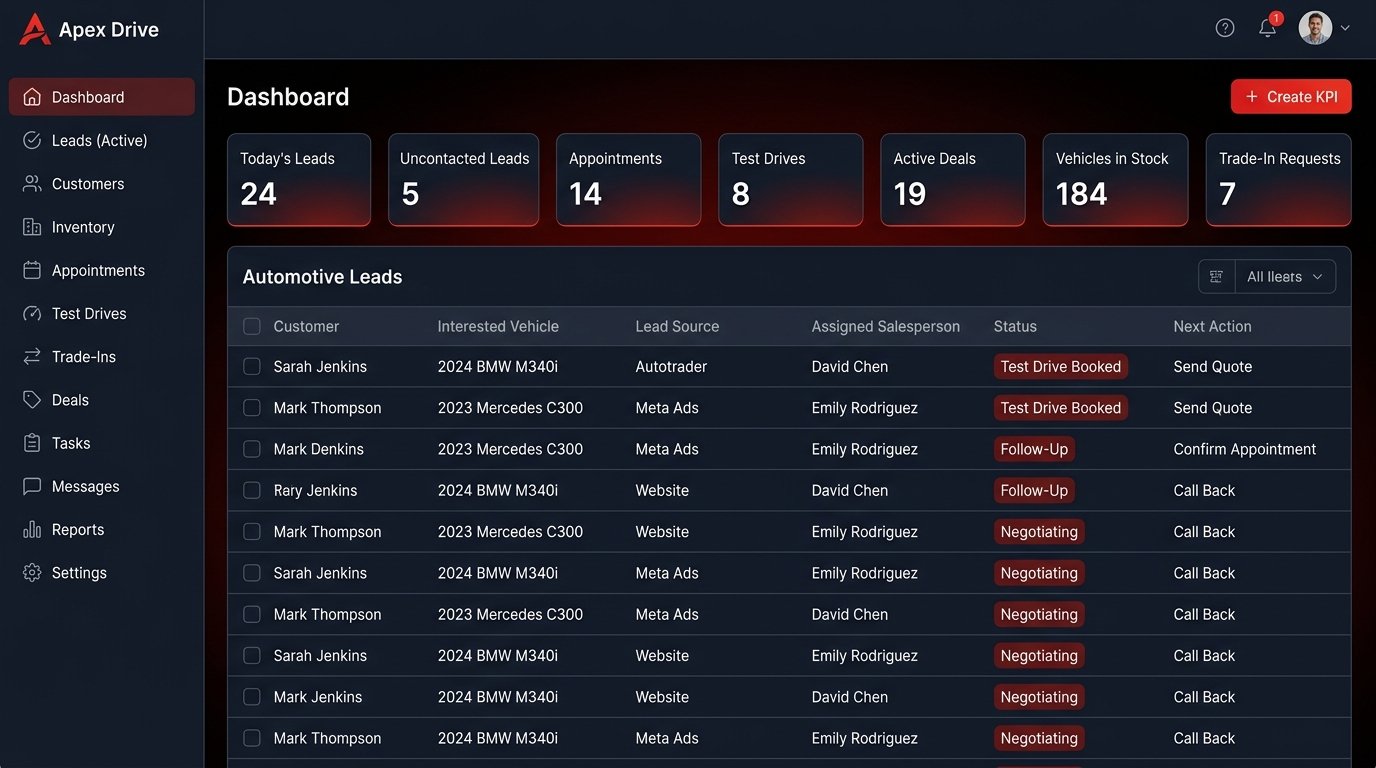

Most companies do not replace their CRM because they hate it. They replace it because the gap between how the software thinks they sell and how they actually sell has quietly widened until the team stopped trusting it.
The symptoms are consistent across industries. If you recognise four or more of these, the CRM is no longer helping you sell — it is a database your team updates after the fact.
1. There is a spreadsheet next to the CRM
Someone keeps the real pipeline in a spreadsheet because the CRM cannot represent a step that matters — a trade-in valuation, a site survey, a deposit, a medical assessment. The spreadsheet is where the truth lives; the CRM is where it gets typed later, or not at all.
This is the clearest signal of all. A parallel system is not a discipline problem, it is a design problem: the tool does not model your process, so people route around it.
2. Leads go cold because follow-up is manual
Response time is the strongest predictor of conversion in almost every high-consideration sale. If following up depends on someone remembering, some leads will always wait hours or days — and those are the ones your competitor closes.
A CRM shaped around your process assigns, sequences and escalates automatically: WhatsApp within two minutes, a call task within an hour, a reminder if nothing has happened by the next morning.
3. You cannot see where deals actually die
Generic pipelines have generic stages, so your reporting tells you deals are lost at 'proposal' — which is true and useless. Losing at 'waiting on finance approval' or 'no valuation within 24 hours' is a fact you can act on this week.
When stages mirror your real steps, the leak becomes visible, and fixing one stage often moves the whole conversion rate more than any amount of extra lead spend.
4. Nobody trusts the numbers
If two people can produce two different revenue forecasts from the same system, the data model is wrong — usually because fields are optional, duplicated across objects, or filled in differently by each salesperson.
The fix is rarely more training. It is a structure where the required information is captured as a natural part of doing the work, not as an admin task at the end of the week.
5. Per-seat pricing is punishing growth
You start limiting who gets a licence. Workshop staff, dispatchers, branch managers and partners are kept out to control cost — so the CRM stops reflecting reality, because the people closest to the customer are not in it.
Any system where the pricing model discourages you from including the people who touch the customer is working against you.
6. Your integrations are people
Someone exports a file every Monday. Someone re-types orders into the accounting system. Someone copies stock levels into a second tool. Those humans are your integration layer, and they are slow, expensive and occasionally wrong.
This is usually the cheapest thing to fix and the fastest payback in the whole project — often before the rest of the system is even finished.
7. The vendor's roadmap is not yours
The feature you need has been 'on the roadmap' for two years. Meanwhile you are paying for eleven modules you do not use, and the one thing that would move your numbers is not coming.
At that point you are funding someone else's product strategy. Building the specific layer you need — and integrating it with what already works — puts the roadmap back in your hands.
Key takeaways
- A spreadsheet beside the CRM means the tool does not model your process.
- Automated, sequenced follow-up beats discipline every time.
- Pipeline stages should mirror your real steps so leaks become visible.
- If per-seat pricing keeps people out, the data stops reflecting reality.
- Manual re-typing between systems is usually the fastest payback to fix.
Services:Custom Software →