
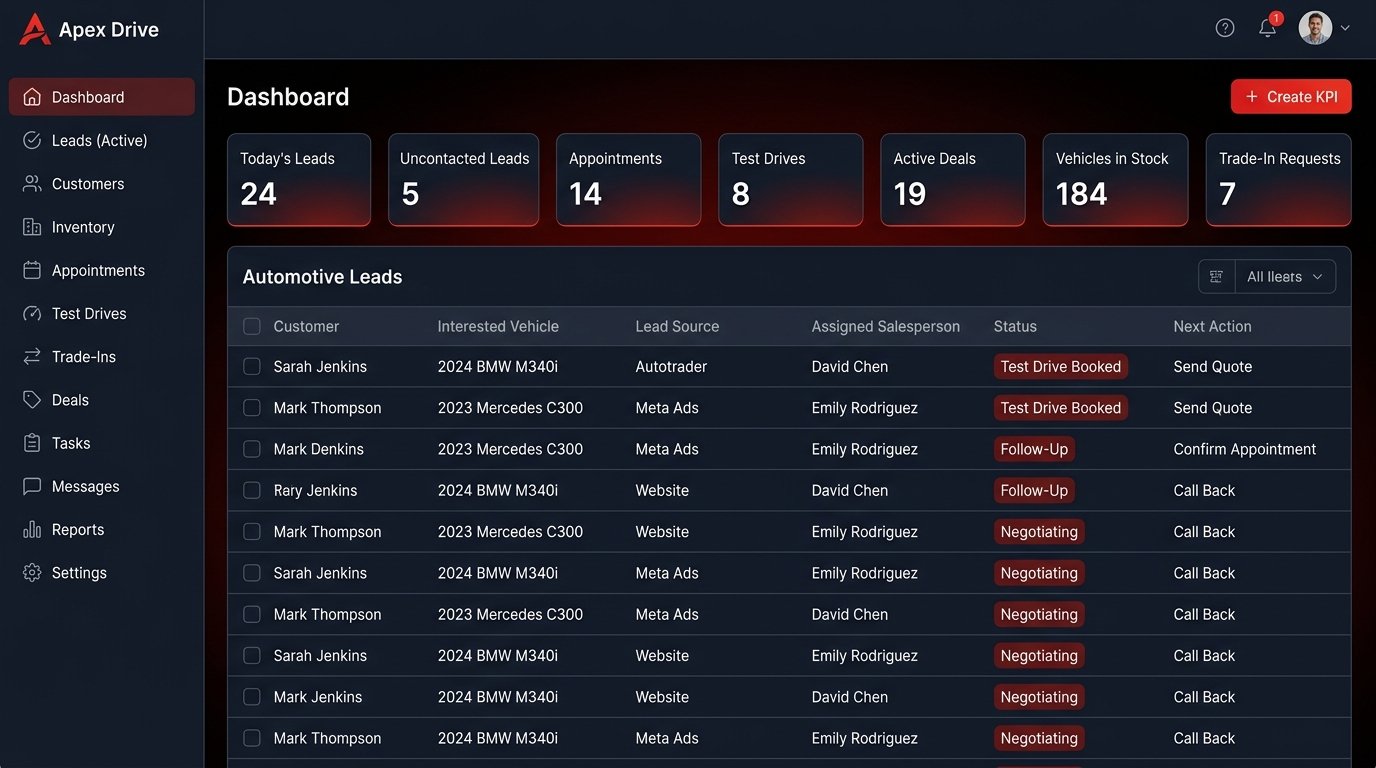
Ask ten dealers what their 'system' is and you will get ten answers: a DMS from the manufacturer, a portal from the classifieds site, an accounting package, a CRM nobody updates, and the WhatsApp group where deals actually happen.
The confusion is understandable, because the categories genuinely overlap. This is what each part is for, and how to decide which gap to close first.
What a DMS is actually for
A dealer management system runs the operational side: stock, purchase and sale documents, workshop jobs, parts, invoicing and the reporting your accountant needs. It is the system of record for vehicles and money.
What most DMS products are weak at is the part before the sale — the enquiry that arrives at 11pm, the trade-in valuation, the follow-up sequence, the test drive that was never booked. They were designed around the transaction, not the pursuit.
What a dealer CRM is actually for
A CRM built for automotive handles the pursuit: capturing enquiries from every channel, responding in minutes, valuing the trade-in, scheduling the test drive, chasing finance approval and keeping the customer warm for the next purchase.
The critical difference from a generic CRM is the vehicle. Interest is in a specific stock item with a specific margin and days-in-stock; the trade-in has its own valuation flow; finance has its own approval states. Generic pipelines model none of that.
Where the money leaks
Two places, consistently. First, response time — enquiries arriving outside working hours that get a reply the next morning, by which point the buyer has messaged three other dealers. Second, days in stock — vehicles quietly ageing past their profitable window because nobody is watching the number daily.
Both are software problems before they are staffing problems. Automated first response and an ageing dashboard that puts the oldest, highest-cost units in front of the sales manager every morning tend to move margin faster than anything else.
Instant valuation as a lead source
Trade-in and 'we buy your car' flows are the strongest lead magnet in the industry, because someone valuing their car is in-market by definition. A valuation tool on your own site captures that intent instead of handing it to a marketplace.
The mechanics matter: plate lookup, condition questions, photo upload, an indicative range rather than a fixed promise, and an immediate handover to a person. Done well, it produces both stock and buyers from the same enquiry.
Multi-branch is a different problem
Once you have several sites, the questions change: who owns a lead that came in for a car at another branch, how stock is shared and transferred, how a group-level manager compares performance without asking five people for spreadsheets.
This is where generic tools break down hardest, and where a system shaped around your group structure pays back fastest — usually in the first quarter, through leads that stop falling between branches.
What to fix first
If enquiries are leaking, start with lead capture and response — it is the cheapest fix with the fastest measurable return. If stock is ageing, start with the valuation and ageing dashboard. If your accountant is the bottleneck, fix the DMS side instead.
You do not need to replace everything. In most groups we keep the DMS and build the sales layer around it, connected by an integration, so the operational side stays untouched while the commercial side finally works.
Key takeaways
- A DMS runs operations; a dealer CRM runs the pursuit. You need both.
- Response time and days in stock are where margin leaks fastest.
- An on-site valuation tool captures in-market intent before marketplaces do.
- Multi-branch groups need lead ownership and stock sharing rules in software.
- Keep the DMS, build the sales layer around it, integrate the two.
Read the full solution:Automotive →
Services:Custom Software →